Lithograph
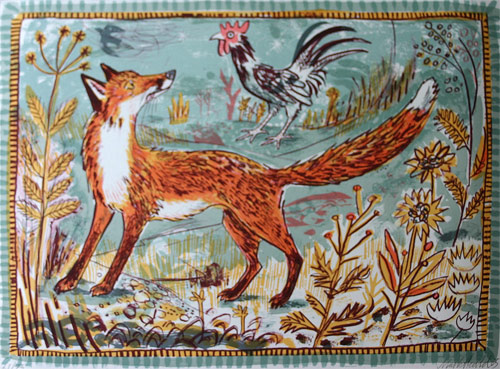

An image is painted or sketched onto a Litho plate (or stone), the plate is then made damp and the image has coloured ink rolled onto it, this image is then transferred to the paper.
The playwright Alois Senefelder is generally understood to have discovered lithography in 1798. His intention was to find an alternative and economical method of printing to those current at the time. Living in Bavaria, he was fortunate in having access to the local Kellheim limestone which was ideally suited to his requirement. The process he developed differs form previous methods, such as Relief printing (woodcut or letter press) or intaglio where the marks are etched or cut into metal plate. With relief methods, the inked areas are all above the basic material whilst with intaglio printing the ink is left in the spaces below the surface to be picked up by the paper when passed through the press. The method created by Senefelder which he described as 'chemical printing' was based on the antipathy of grease and water interacting on a perfectly flat surface.
He found that if a limestone slab was suitably prepared and levelled, marks made with grease-containing elements, could, when processed with gum arabic solutions and dilute nitric acid, be made to form printable images.
Printing the marks entailed first damping the stone with water before inking the images with oil bound pigments. This sequence - first water and then printing ink - has always been the basis of lithographic printing.
The idea and its possibilities spread rapidly throughout Europe and eventually the USA. In 1801, Senefelder and his business partner, Philip Andre, spent the year in London establishing the invention.
It wasn't until the 1820s however that the process attracted many artists including Goya and then later into the 20th century such artists as George Grosz.
Other developments in the 1840s and 50s began to influence the creative course of lithography, but it remained for the French publisher Cadart to stir contemporary artists' interest in lithography. Edouart Manet and James McNeill Whistler all introduced different approaches to making artist's lithographs. It was Whistler however who began the practice of signing and numbering prints.
Today, the older technologies of stone and zinc plate lithography are still available, although Senefelder's discovery has progressed a long way since 1798, with particular radical changes over the last twenty years. Lithograpy today still offers an artist new and enriching possibilities for image making. As Felix Man said 'a medium of such range, force and delicacy as to satisfy the most diverse individuals'.
excerpts from 'Aspects of the Royal Academy'