I've often wondered what really draws us to a particular work of art. Is it our own instinctive response, or are we influenced by an artist's reputation, a gallery's standing or a sense of aspiration? Looking back at my own journey, from knowing very little about visual art to discovering pieces that genuinely moved me, I've been reflecting on how our tastes develop, how confidence grows with experience, and why, ultimately, trusting our own response to art might be the most important thing of all.
As a child, I wasn't introduced to the delights of visual satiation. Our family's arts involvement had been musical. I could have hummed the Bach Double Violin Concerto at the age of 12 — all three movements — or explained broadly the sequence in which the periods transformed musical repertoire and complexity by the age of 14. But ask me to identify a Constable reproduction, or an original print, and the conversation would have been seriously lacking.
I recall vividly my first trip to Athena, furnishing my first flatshare room. My own visual canvas was empty. What was I looking for? Did colour matter? Where should I hang my newly acquired posters? Should I get one or two, serious or funny? The list goes on. Eventually I came away with something as bland as it was unremarkable. At that point I didn't really consider that art could be anything other.
Over time and homes, I did purchase wall decoration — a holiday memento, or a cheap poster with a message that resonated.
When I met my husband, we visited Brook Gallery, at that time owned by my predecessors. It was a small, overhung gallery space in a strangely named place called Budleigh Salterton. I'd never met Roger and Fiona before, but some of the names on the wall were strangely familiar — Frink and Matisse come to mind. Yet in that visual cacophony, my attention was drawn to pieces whose authors were unknown to me: Irvin, Frost, Lintine, Grigor. The work felt animated.
In that two-day visit I learned more about artists — some of whom I am embarrassed to confess I was unaware of, some of whom were just plain brilliant but whose work, for whatever reason, might never be placed in the upper echelons of artistic ranking. I realised that some work resonated and other pieces left me cold. Some made me smile inwardly; others made me want to look away.
On that first visit, we purchased three pieces. One because the tones of yellow were so strong the piece would stand its ground anywhere. One because it made me think of my very favourite piece of furniture — my piano. The two have moved happily hand in hand for the last 28 years. The third was my husband's choice: he had become mesmerised by an explanation of the technique — drypoint — and developed a regard for the artist that I only wish we could convey to him directly.
So while these ramblings might not appear to address the question in hand, I have often wondered whether I was influenced by the company that my newly acquired works were keeping — or whether I was responding to an intrinsic sensibility that needed to be satisfied. In actual fact, the fact that these pieces hung on the walls of fame meant that my aspiration, if it existed, was already satisfied. All I then needed to consider was my own response to the work.
As the gallery model develops further, it will play a greater part in setting the scene before a viewer ever comes into contact with a work of art. London locked-door galleries will carry a certain weight of occasion. A major auction house will provide a more salubrious avenue of purchase than a market stall.
Perhaps aspiration and knowledge are not quite diametrically opposed — but they do seem to occupy inverse positions on the same scale. The less we know, the more we reach outward for reassurance: the gallery's reputation, the artist's rank, the price as a measure of worth. As knowledge grows — even just the quiet knowledge of one's own responses — that reach becomes less urgent. Aspiration doesn't disappear. It simply has less work to do.
One might argue that the real question is not whether buying art should be an exercise in aspiration — but where on that scale one comfortably sits.
works related to this journal.
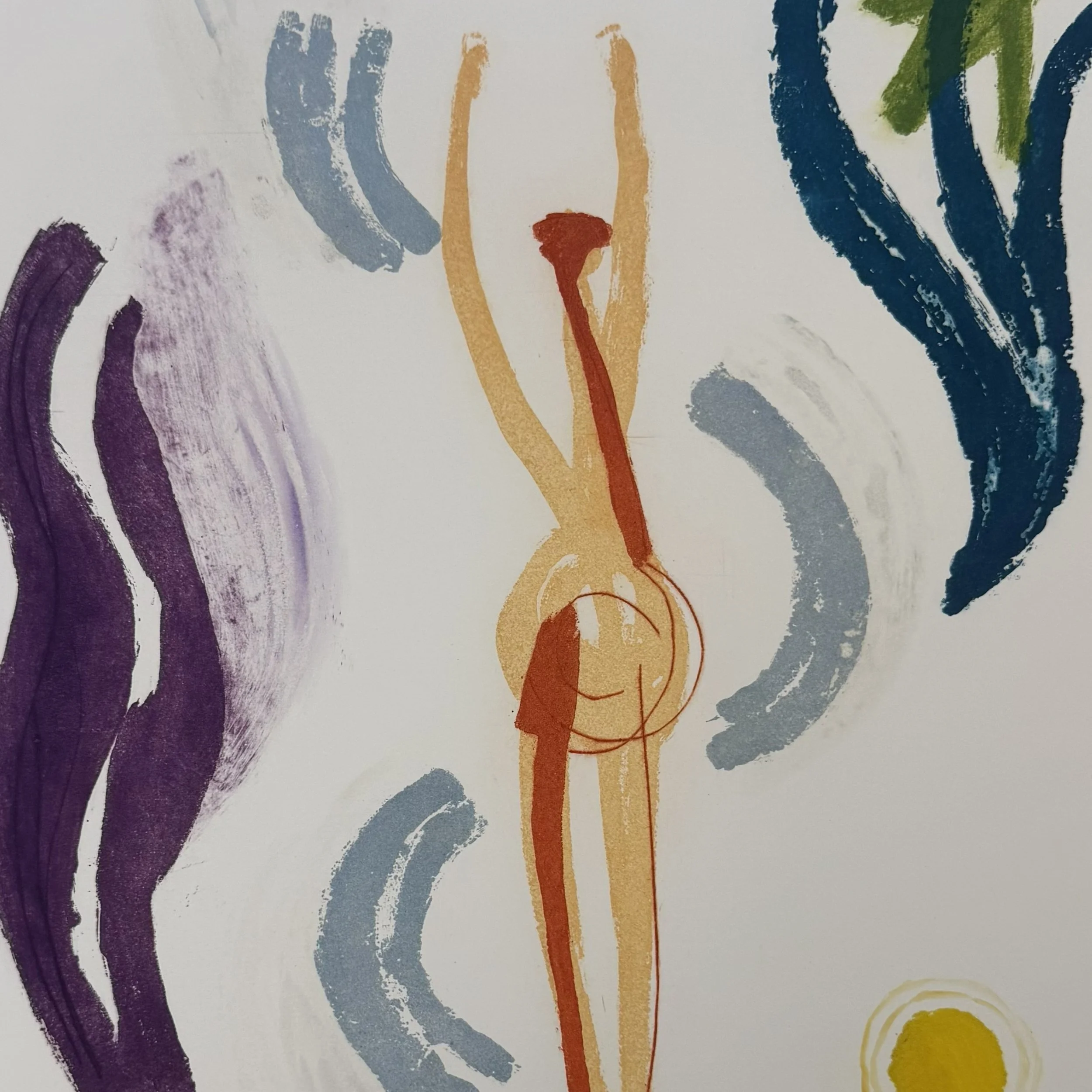
Catalogue
Medium: Etching
Edition: Limited (A/P)
Paper Size: 69.5 x 56 cm
Image Size: 51 x 40 cm
Provenance: Artist’s studio
View artist profile: Rachel Grigor